Welcome to Hacienda Ford! Located in Edinburg, TX, Hacienda Ford is proud to be one of the premier dealerships in the area. From the moment you walk into our showroom, you'll know our commitment to Customer Service is second to none. We strive to make your experience with Hacienda Ford a good one – for the life of your vehicle.
Thursday, December 4, 2014
Ford adds 850 jobs to build 2015 F-150 | Hacienda Ford
Pickup trucks tend not to advance at quite the same pace as the rest of the industry. That's what makes the new Ford F-150 so remarkable, jettisoning its old steel construction in favor of aluminum. It's a game changer that Ford is betting big on, and in anticipation of surging demand, the Blue Oval automaker is adding 850 new jobs to put the thing together.
Those 850 new employees will be centered at Ford's Rouge complex in Michigan – with 300 at Dearborn Stamping, 50 more at Dearborn Diversified and 500 at the Dearborn Truck facility, the latter of which has already kicked off what Ford describes as "the largest manufacturing transformation in decades." Old manufacturing equipment is being replaced with the latest technologies, and even the Ford Rouge Factory Tour is undergoing a complete overhaul.
The new jobs come as part of the commitments Ford made to the UAW in 2011 to create 12,000 hourly jobs in the United States by 2015 – a number which Ford has already exceeded at 14,000. Over 4,000 of those are centered in southeastern Michigan.
Labels:
2015 ford f-150,
dearborn,
Ford,
ford f-150,
Hacienda Ford,
jobs
Location:
Edinburg, TX, USA
Monday, November 24, 2014
Five Habits that will Ruin your Vehicle | Hacienda Ford
Avoiding these habits can go a long way in preventing an expensive repair bill.
Most things you own will last longer if you take care of
them and treat them well. Your car is no exception to this rule. While
neglecting your car may seem harmless in the short term, regular neglect and
mistreatment will add up and will reduce your car’s lifespan. To keep your car
running longer and stronger, avoid these five harmful habits.
1. Delaying regular maintenance
Regularly maintaining your car is vital to your car’s
longevity. Regular maintenance includes oil and filter replacement, as well as
transmission fluid, air filter and brake pad care. Every vehicle
manufacturer specifies a different maintenance routine, which can be found in
your owner’s manual. While regular maintenance requires you to invest some time
and money, it’s peanuts compared to the cost of a new engine or transmission.
2. Ignoring dash warning lights
When a warning indicator lights up on your dash panel, it’s
important to address the problem immediately. If you don’t know what the light
means, check your owner’s manual or call your mechanic. Dash warning
lights can alert you to some very serious problems, such as a
coolant leak, which can cause your engine to overheat. A simple
preventative repair can often prevent a large problem down the line.
3. Shifting while moving
The transmission is one of the most complex and expensive
parts in your car and it’s important to use is as it was intended. Be careful
not to shift from drive to reverse or vice versa while the car is still moving.
This “jerky” shifting places excess strain on the transmission’s internal gears
and can instantly destroy it.
4. Jerky driving
We all know someone who accelerates wildly on every straightaway
only to brake hard at a traffic light or stop sign. This type of
driving won’t destroy your car immediately, but will cause your engine,
transmission and brake system to deteriorate much more quickly than
intended. Cars that have been abused will have premature fluid leaks, broken
seals and mechanical problems.
5. Putting off tire replacement
Tires for some cars can be expensive, so replacing them is
an unwelcome cost. Driving on bald tires is very risky, however. If a tire
blows out while you’re driving, you can lose control of your vehicle and have a
serious accident. And if you drive with bald tires in the rain, the risk of
hydroplaning goes up tremendously. A new set of tires may seem
pricey, but probably costs less than your car, and even less than
your insurance deductible.
Labels:
Auto Maintenance,
Auto Repair,
Auto Service,
Hacienda Ford,
Mechanic,
New Tires,
Oil Change,
Tires,
Transmission
Location:
Edinburg, TX, USA
Wednesday, November 12, 2014
Is The 2015 Ecoboost Mustang More Fun Than A Fiesta Or A Focus ST? | Hacienda Ford
The first turbocharged Mustang in more than three decades is certainly a huge step up from the rental car that the V6 Mustang is, but is it fun enough to provide a real alternative to the GT?
This 2.3 is not that 2.3 you might remember from 1984. The 2015 Mustang's Ecoboost comes with a twin-scroll turbo, direct injection, forged connecting rods and a forged crankshaft, a high-pressure die-cast aluminum block and piston cooling oil jets. That's why it has a lot of torque at lower revs and in the midrange, but it's also tuned to lose most of its grunt as you get closer to the redline.
The claimed 310 horses are more like 279 at the wheel according to Motor Trend's dyno test, and they have to move roughly 3600 pounds which means the turbo Mustang is far from being the wildest pony out there.
It certainly wasn't built for the track, but let's see what's it like to drive one at speed for the first time:
Location:
Edinburg, TX, USA
Thursday, October 23, 2014
Secrets Behind the New Ford Power Stroke Diesel | Hacienda Ford Edinburg TX
Secret #1: Ford engineered its own powertrain for the 2015 Super Duty®
Secret #2: The 6.7-liter Power Stroke® V8 makes more horsepower and torque than the previous model
Secret #3: First rule of the Power Stroke? There are no secrets
The design of the 6.7-liter Power Stroke V8™ is something you would think would be cloaked in darkness, even within the walls of the Blue Oval. ™ Not so – Ford is proud of what it accomplished with the second-generation diesel model optional in the 2015 Super Duty, and admitted building an efficient engine* required a lot of openness. “Keeping everything in-house gives a competitive advantage because there are no go-betweens,” explained David Ives, Ford Power Stroke Technical Specialist. “The engine guy can just walk over to the transmission guy and they can work together to find the best solutions, breaking down barriers.”
The upgrades to the Power Stroke resulted in 440 horsepower – the previous 6.7-liter Power Stroke made 400 – and 860 lb.-ft. of torque – up from 800. This pertains to all Super Duty models, from F-250 to F-450. That’s what happens when you engineer a work truck to be a work truck, and as a team. Ford is the only manufacturer that develops and builds its own powertrains in this class. And there are innovations galore: a compacted graphite iron engine block and reverse-flow layout. About that no-secret rule? “Strong communication built a better diesel truck,” David added.
“The designers of the original 6.7-liter Power Stroke V8 Turbo Diesel predicted that it would eventually need to be upgraded for higher output,” said David. “They designed it in a way that made it easier to add a larger turbocharger, increasing airflow and creating more power for dramatically improved performance, yet we haven’t lost any efficiency.”
So, looks like the cat is out of the bag: This purpose-built truck has been improved from (cylinder) head to tow.
*Based on Ford simulated city-suburban drive-cycle tests of comparably equipped 2015 Ford and 2011-2013 competitive models, consistent with SAE Standard J1321.
Labels:
Auto,
Automotive,
Diesel,
Edinburg,
Ford,
Ford Trucks,
Hacienda Ford,
super duty,
Texas,
Towing
Location:
Edinburg, TX, USA
Friday, October 10, 2014
Ford Marks 20 Years of Fighting Breast Cancer with Warriors in Pink | Hacienda Ford Edinburg, TX
This year marks 20 years of Ford Motor Company fighting against breast cancer. The company’s journey began when it became one of the first corporate sponsors of the Susan G. Komen Race for the Cure. Ford branded its initiative Warriors in Pink® and developed a full line of clothing and gear that donates 100 percent of the net proceeds to four breast cancer charities. Thus far, Ford has dedicated more than $125 million to the cause.
Involvement for Ford extends far beyond just financial support for research. Warriors in Pink encourages women to have continuing and honest conversations that keep them proactive about breast health and early detection.
“Through Warriors in Pink, Ford continues to be a unifying force in driving awareness for breast cancer. This year is especially meaningful to us as we mark our 20th anniversary and honor the strength and courage of all the survivors who have shared their stories with us throughout their journey,” said Joe Hinrichs, President of The Americas, Ford Motor Company.
Other ways Ford has been able to shine a spotlight on survivors is through its Models of Courage program, which highlights individuals who openly share their experiences with breast cancer.
Since 2006, Warriors in Pink has offered a line of apparel and accessories, and 100 percent of the net proceeds from the sale of these items benefit Warriors in Pink’s four charities partners: The Pink Fund, Susan G. Komen, Dr. Susan Love Research Foundation and Young Survival Coalition. Join the fight and support a breast cancer charity of your choice.
Location:
Edinburg, TX, USA
Wednesday, September 10, 2014
The Tale of the Printer and the Two-Seat “Shorty” Ford Mustang
Back
in the early 1960s, as Ford Motor Company product planners, designers
and engineers were brainstorming ideas for a compact sporty car, there
were numerous proposals for two-seaters. Most of those concepts never
got any further than sketches, but at least one running prototype of a
two-seat Mustang was built and survives today thanks to the devotion of
Bill Snyder of Hudson, Ohio.
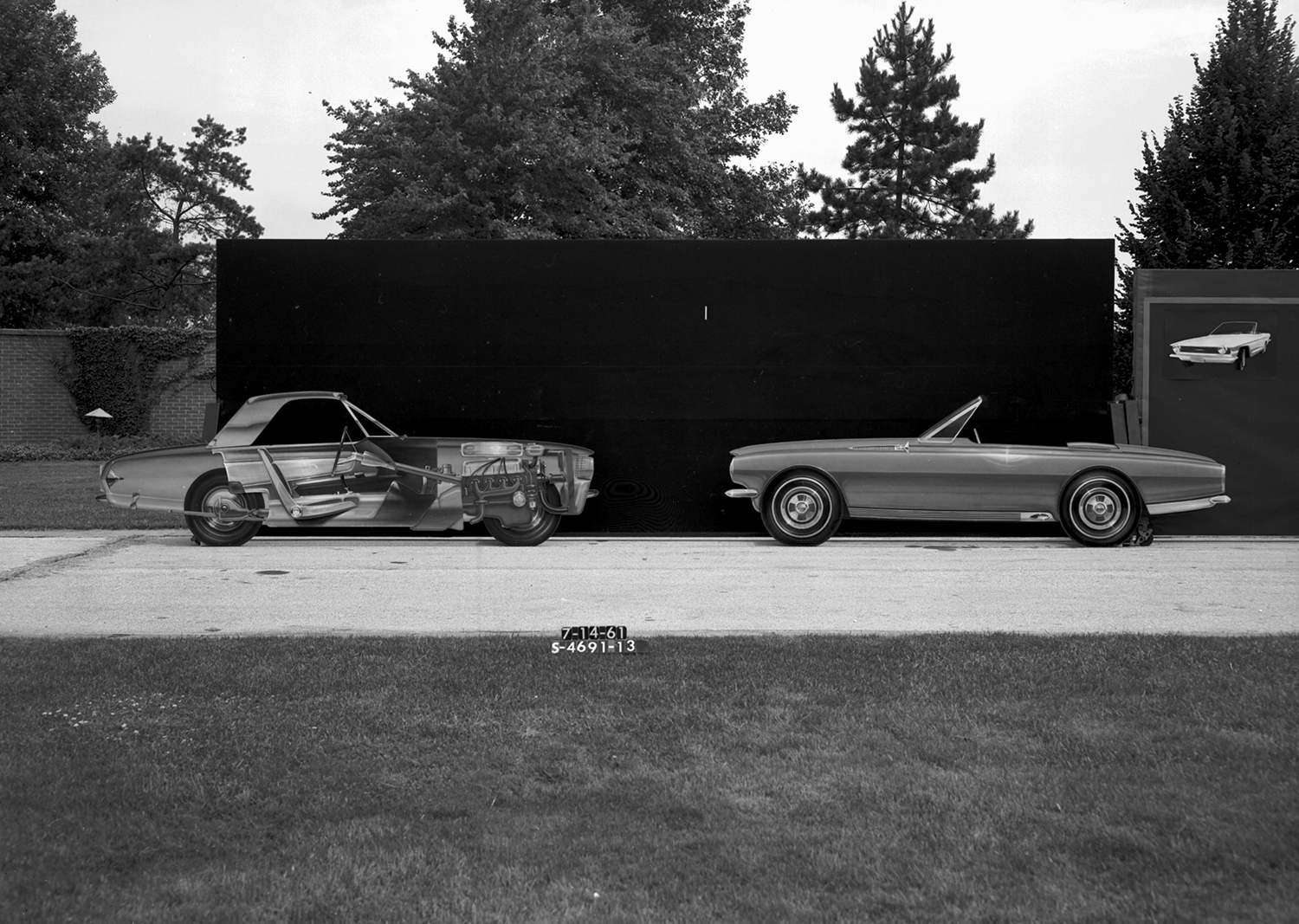
The “shorty” Mustang, as it is often called, was designed by Vince Gardner and built in 1964 by long-time Ford supplier Dearborn Steel Tubing for a traveling custom car show. Now known as DST Industries, the company still builds and prepares many Ford prototype, concept and show vehicles.
“I saw the shorty Mustang during one of the stops of that traveling car show and decided I had to have one,” said Snyder. “I told a Ford rep I wanted to buy a two-seat Mustang to go along with my then 10-year-old Corvette, but he said it was a one-off that they were never going to build.”
The owner of Ohio-based screen printing company Nordec Inc., Snyder has always been a sports car fan. Although Snyder was hugely disappointed, he nevertheless kept an eye out in case Ford ever did produce a similar car. It turns out patience truly is a virtue, and several years later Snyder ended up owning exactly the car he saw on that show stand.
How did this car come to be?
After choosing a Gale Halderman-penned two-door hardtop as the basis for the production Mustang in the fall of 1962, the Ford design team continued to look at possible alternatives for expanding the lineup. A convertible joined the hardtop at Mustang’s launch in April 1964, with a fastback coming a few months later. Body styles that were considered and rejected included a four-door sedan and even a two-door station wagon.
Early on in the program, two-seaters were frequently pitched as potential replacements for the late, lamented first-generation Thunderbird, which by that point had grown into a luxury four-seat coupe. However, two-seaters then and now are niche products and Ford wanted its new car to have a broader appeal including young families, so the decision was made that the car would have four seats.
Despite that, when an opportunity arose to build a custom Mustang for an upcoming traveling car show, DST brought in freelance designer Gardner to take another shot at a two-seat Mustang. It’s not known if Gardner ever saw or had access to rejected Ford design studio sketches, but the concept crafted by the DST team bears a strong resemblance to at least one sketch from February 1963.

The resulting car is a
Mustang fastback with 16 inches removed between the rear edge of the
door and the rear axle. Working with one of the preproduction 1965
Mustangs that otherwise would have been sent to the crusher, the DST
fabricators created unique rear bodywork from fiberglass and new outer
door skins that incorporate the classic Mustang side scoop.
When the tour where Snyder had seen the shorty ended, the car, which was rejected for production, was set to meet the same fate as most such cars – the crusher. Not wanting to see this unique Mustang destroyed, Gardner stashed it away in a nearby warehouse.
Several months later, after Ford reported it stolen and received an insurance payout, the warehouse owner discovered the car. Since Gardner had apparently not paid any rent, the insurance company that paid out the claim took possession of the car and later sold it to one of its executives.
Shorty finally finds a home
Four years after he first saw the shorty Mustang at the car show, Snyder spotted it once again, this time listed in the for sale section of Hemming’s Motor News.
“I contacted the seller and immediately sent a driver from my printing business to Connecticut to pick up the car,” said Snyder. “I’ve owned this one-of-a-kind Mustang for the last 46 years.”
Over time, the original auto show lacquer finish cracked and the car was sprayed with body primer as Snyder accumulated about 15,000 miles on the car. Before it went on the show circuit in 1964, Ford engineers installed a special engine. The original 260 cubic-inch V8 that was available in Mustang was bored out to 302 cubic-inches and a trio of two-barrel carburetors were installed, making this effectively a prototype for one of the most beloved engine configurations in Mustang history.
When Snyder decided to restore the car several years ago, his wife found some of the original color under the hood and worked with a paint supplier to match it exactly. Since it was a concept car, the original builders had used plexiglass for the quarter windows and backlight rather than cutting custom glass. Despite being heavily fogged after nearly 50 years, the restorers were able to buff the windows back to their original clarity.
Looking as good as or better than it did in 1964, the one-of-a-kind, two-seat shorty Mustang made its debut at the 2013 Amelia Island Concours d’Elegance in Florida. This year, Snyder has been taking it to a variety of events celebrating 50 years of Mustang.
Wednesday, September 3, 2014
TRUCK OF THE YEAR
THE ALL-NEW EXPLORER COMBINES GROUNDBREAKING TECHNOLOGY, THE BEST V-6 HIGHWAY MPG, NO-COMPROMISE POWER AND THE ABILITY TO HANDLE ANYTHING YOU THROW AT IT.
Under the hood, a powerful V-6 engine delivers fuel economy to envy.
It takes only one glance at the stunningly sleek, aerodynamic design of the 2011 Explorer to see that Ford has completely reinvented the classic American utility vehicle. But the features that recently won it the North American Truck of the Year award—given by a jury of veteran automotive journalists who judge on factors that include innovation, performance, safety, handling, driver satisfaction and value—can be found under the hood as well. Explorer sports a standard 3.5-liter V-6 engine, electric power–assisted steering, available 5,000-pound towing capability and available technologies including Intelligent 4WD with Terrain Management System. And the 2011 Explorer holds the distinction of having the best V-6 highway mpg.* No wonder it’s driving off with all the awards.
Check out all of the 2011 Explorer Go.Do.Adventures.
*EPA estimated 25 hwy mpg, V-6 FWD. Class is Three-Row Large Utilities, nonhybrid.
Subscribe to:
Posts (Atom)